THE ROLFING TEN-SERIES
The Rolfing® “Ten Series” can be viewed as a basic recipe which all Rolfers™ follow to achieve our common goal of balancing a client’s body in gravity. However, every Rolfer and every client are unique and so we adapt the recipe to suit specific needs. Though it’s important to address your needs, it is also important to not hold specific expectations, but instead, stay curious and open to the present moment. That is where the gifts lie - where healing happens more generously.
That said, the description below can be viewed as a general outline of the goals and procedure for each of the ten sessions.
1: Freedom to breathe
The first session begins a conversation with your whole system.
While we will absolutely start addressing any specific structural concerns you’re carrying, the deeper intention of Session One is to support your breath. Breath is foundational. It reflects how you meet life, how you organize in gravity, and how much space you allow yourself to inhabit.
Through precise, skillful work with the fascia of the ribs, diaphragm, shoulders, neck, and head, I invite more ease and responsiveness into your breathing pattern. Rather than forcing change, we create through our collaborative attention, the conditions for a more balanced and efficient breath to emerge—one that feels spacious, supported, and alive.
We also begin organizing the lower body by bringing awareness and mobility to the pelvis, hips, and legs. This early work helps the pelvis begin to “horizontalize,” offering a more stable and adaptable base for the spine and breath to rest upon.
You’ll leave with simple, individualized cues—things to notice and explore in your daily life—so that your breath becomes not just something that happens, but something you are in relationship with. This is the beginning of restoring length, support, and a more easeful way of being in your body.
2: Finding support
Session Two brings us, from above, down to earth.
Here, we focus primarily on your feet, lower legs, and knees—your foundation in gravity. The way your feet meet the earth influences everything above them. When this base is compressed, braced, or unclear, the rest of the body must compensate.
Through thoughtful fascial work and movement exploration, I help restore adaptability and responsiveness in the feet and lower legs. We invite more articulation, more yield, and more support so your structure can organize upward with less effort.
As your contact with the ground becomes clearer, something deeper often shifts. A more embodied sense of “length” begins to emerge through the head—a felt sense that you are here; in relationship with the earth, suspended and supported. From this grounded stability and effortless lift, it becomes easier to move forward—not just physically, but mentally and emotionally as well.
This session is about belonging in your body, locating the spaciousness of possibilities and trusting the ground beneath you.
3: Creating space and owning your place
Session Three begins to clarify your side body and your relationship between front and back.
Here, we work along the lateral lines of the legs, arms, ribs, neck, and head—bringing attention to the often-overlooked side seams of the body. As these tissues become more available, a new balance between front and back can emerge.
You may feel less pulled forward or braced backward, and more centered within yourself.
We continue freeing the breath, inviting the ribs into a more dynamic, four-way movement—forward and back, side to side. The breath becomes more three-dimensional, less restricted, more conversational.
There is also an energetic component to this session. As the sides open, many people sense a clearer current running from sky to ground along the lateral body—a vertical continuity that connects upper and lower, inner and outer.
This is a session about finding your vertical axis through the sides of yourself, standing in length without rigidity, and allowing support to move through you rather than holding yourself up alone.
4: Finding your core, connecting earth to sky.
Session Four begins to gather you inward.
In this session, we cultivate deeper support through the inner line of the body—from the inner arches of your feet, up along the inside of the legs, into the pelvic floor. This is where a more centered sense of vertical core begins to organize. Rather than gripping or bracing, we evoke a felt sense of inner lift and continuity.
As this inner support becomes clearer, I also work with the deeper layers that influence the spinal curves—creating more length and ease, and less compression. The spine is not forced to straighten; instead, it begins to flow in it’s its natural, resilient curves in a buoyant relationship with gravity.
Energetically, many people begin to sense a more consistent subtle current rising through the midline—from ground to sky. A quiet inner buoyant center. A sense that support is moving up through you, rather than something you must manufacture from effort.
This session is about discovering core support that feels steady, alive, and deeply connected, within and without.
5: Activating the core
Session Five is where we begin to reclaim your walk.
In evolutionary terms, standing upright is still relatively new for us as humans. Ida P. Rolf often spoke about how, compared to our four-legged cousins, we are still learning how to move efficiently on two feet. In many ways, we’re still toddlers in gravity.
This session is devoted to the art of walking with greater ease and intelligence.
We focus on connecting the legs into the spine through the iliopsoas—the deep, responsive muscle that links your inner legs to your lumbar spine and diaphragm. When this pathway is organized, the effort of walking shifts. Instead of pulling yourself forward with tension in the hip flexors or compressing the low back, movement begins to ripple upward through the spine, like a releasing spring.
We explore the idea of the “spinal engine”—allowing rotation and flow through the torso to generate momentum. This greatly improves efficiency and reduces unnecessary strain, especially in the lumbar spine and hips, where so many people hold chronic tension or pain.
Session Five is about discovering that walking doesn’t have to be effortful. It can feel fluid, supported, even beautiful and joyful—like your whole system is participating in moving through awaiting space.
6: Freeing the spine
Session Six deepens and refines the work we began in Session Five.
Now that the legs and spine have begun speaking more clearly to one another, we turn our attention to the back body—where long-held patterns often live behind awareness. Through focused work with the back, pelvis, and legs, we begin to unwind restrictions that limit fluid transmission through your structure.
This session invites a more conscious relationship with your back space. As tension softens and layers differentiate, somatic awareness grows. You may begin to feel movement as subtle flow—an internal conversation.
A key intention here is restoring a two-way current through the spine: upward and downward, ground and sky, support and expression. Instead of imaging it as a force that travels in one direction, the spine becomes more responsive, more resilient, more alive in it’s bidirectional reality.
Session Six is about freeing the back body so that support can move through you with less holding and more trust.
7: Getting the head on straight
Session Seven brings our attention to the head—your perceptual center—and its relationship to gravity.
If you struggle with saying “yes” or “no,” experience persistent back ache, eye strain, TMJ discomfort, headaches, or even vertigo, it can sometimes reflect how the head is organizing (or not organizing) over the spine. When the head is held slightly forward, tilted, or braced, the entire system compensates.
Balancing the head on the shoulders is a vital piece of the embodiment puzzle. A well-organized head doesn’t hang, jut, or grip—it floats. And when it floats well, the spine is free, like a dragon’s tail and the nervous system can come to a settled place.
In this session, I continue easing restrictions in the upper back, shoulders, and neck, and begin more detailed work with the muscles and fascia of the face—including the jaw and the inner mouth. We invite a more harmonious relationship between cranium, spine, and jaw, allowing expression and support to coexist.
At times, I may incorporate gentle craniosacral techniques to support balance in the cranial rhythm and encourage deeper regulation.
Session Seven is about clarity and alignment—helping your head feel called upward by space rather than held and heavy, so you can meet the world with steadiness, softness, and alignment.
8: Putting it all back together
Session Eight begins the integration phase of the Ten Series.
By now, you know that your system has changed. Patterns have shifted. Support is more accessible. And what is uniquely yours—your particular structural story—comes clearly and more resolved into the foreground.
This session is a focused opportunity to address any remaining, specific imbalances that continue to ask for attention. We refine. We differentiate. We listen closely to what still feels incomplete or asymmetrical, and we work with precision and respect for the whole.
Session Eight is the last moment in the series where we zoom in before we begin weaving everything back together in Sessions Nine and Ten.
It’s a powerful turning point—where your structure feels both more individualized and more coherent, preparing for full-body articulation in the world.
9: Integration
Session Nine continues the integration process with humility and perspective.
Rolfing is not about perfection. It’s about supporting your body to organize as well as it can in its present state of being. By this point in the series, your system has received a tremendous amount of new information—structural relationships have shifted, movement options have expanded, and your sense of support has likely deepened.
Now we begin asking: How is this landing? What is becoming embodied?
Session Nine helps ensure that these changes are integrating in a way that feels coherent and sustainable. We work with the whole person—structure, movement, perception—so the new possibilities don’t just exist on the table, but in your daily life.
This phase of the work is also an initiation. As your body reorganizes, awareness often widens—both consciously and subconsciously. You may notice new choices emerging: how you stand, how you speak, how you respond.
Together, we clarify what feels essential to continue exploring, and what can simply be acknowledged for now. Integration is not about doing more—it’s about allowing what has shifted to take root.
10: Closure
Having worked through all planes of the body multiple times over, enhancing the effectiveness of breathing and resolving old patterns for new ones, it’s time to reflect on what has been gained from the process and what will continue to unfold.
What is a session like:
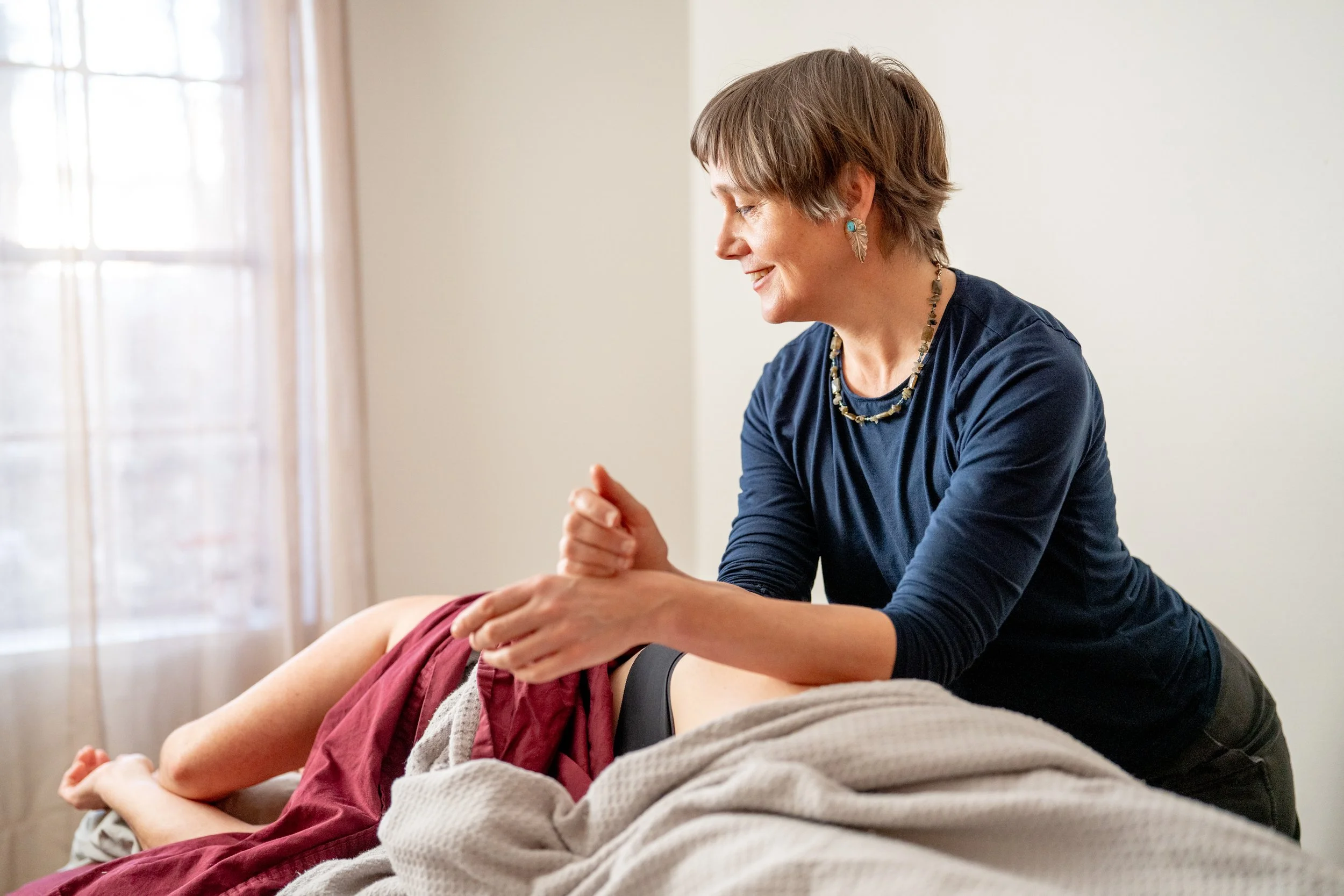
During a Rolfing session, there is time dedicated to the manipulation of fascia and time spent in education in gravity (Rolfing Movement).
I listen to your needs and real life experience and then look at your postural alignment as you stand and walk, and ask you to notice what ever sensations you may notice. These observations, as well as, several manual tests, allows me to approach your symptoms in their globalism along with a personal strategy for your session.
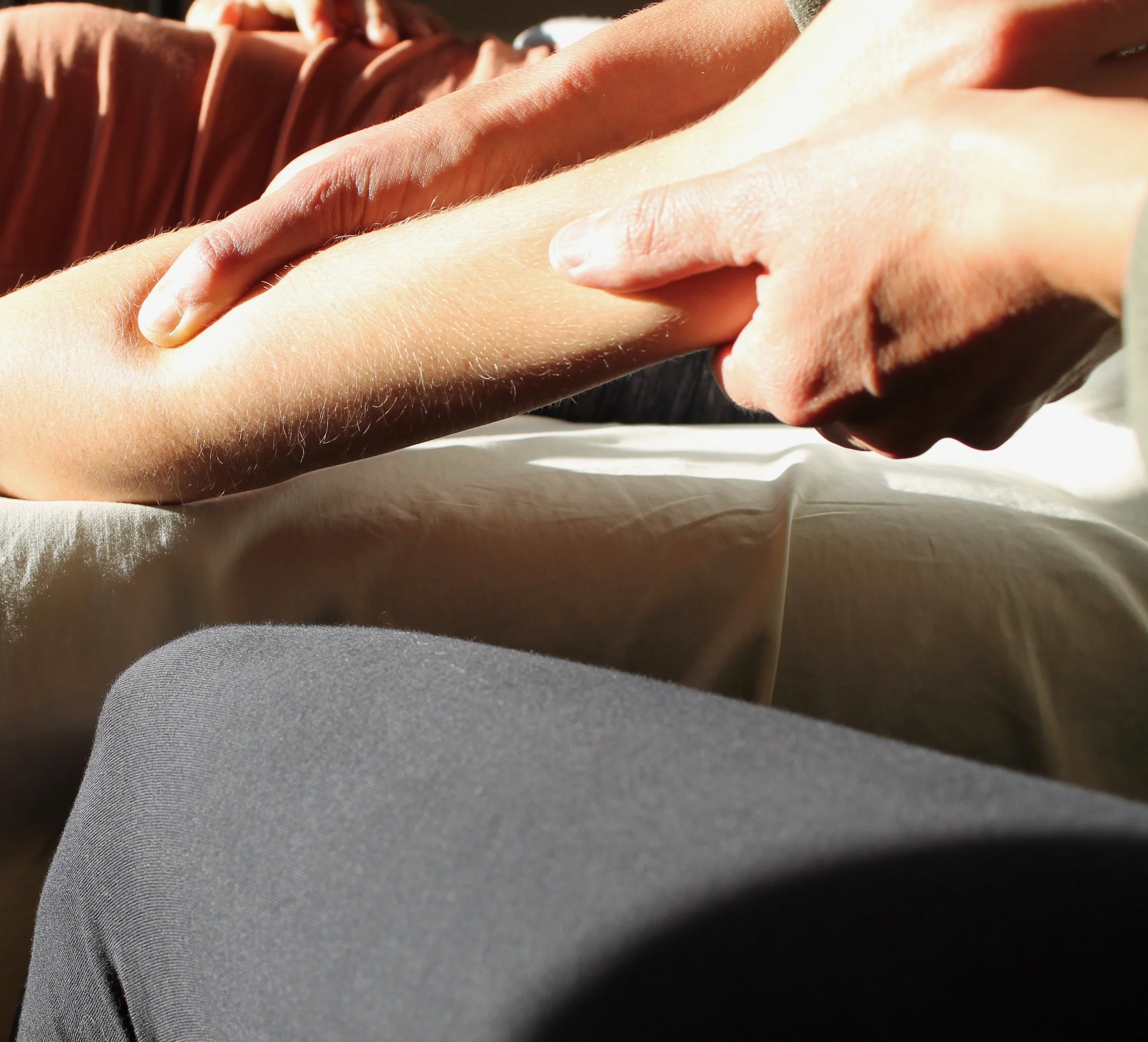
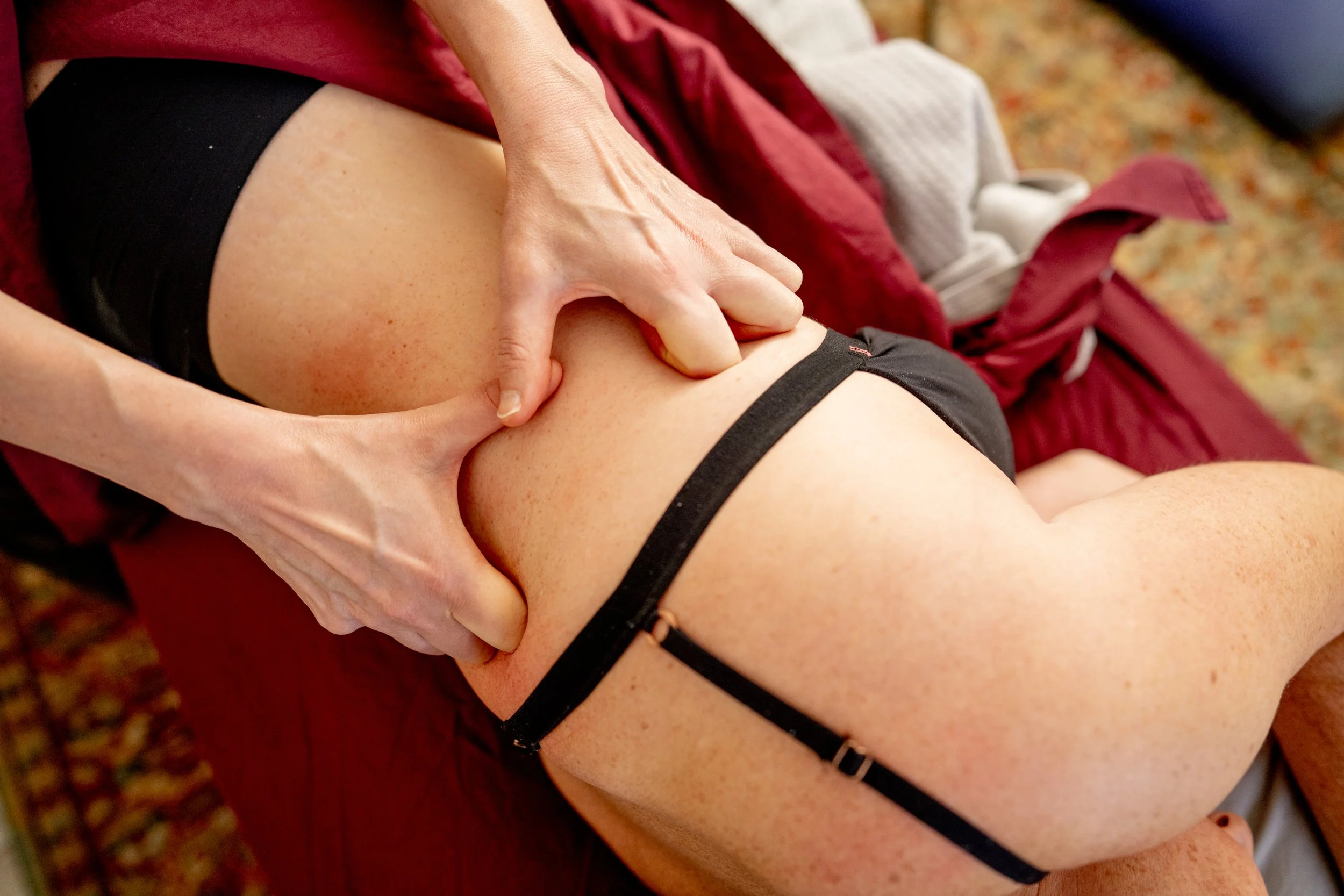
I then invite you to lie down on a massage table and with my hands and forearms, I work progressively with your physical structure, or the substance that connects everything in the body together like a net. Light and deep pressure with direction generate suppleness and fluidity to the different tissues. Little by little, they become organized and balanced and your overall tone improves.
As we progress together through the series, I invite you to welcome new perceptions that these changes provide and propose simple movements to enhance that, helping you to be present to your impressions and your new ways of moving. Enhanced circulation implements itself in the areas being worked, allowing better relationships between different body parts and greater efficiency and ease of movement. The autonomic nervous system also balances itself, permitting a healthy alternation between states of alertness and relaxed attention.
Once you return to a vertical position – sitting, standing or walking – I propose a short period of time to pay attention to how your posture is transforming itself, giving access to a new coordination of movements and appreciation for a state of embodiment that you can access and work with at any time.
Many new perceptions emerge: the feeling of the feet being anchored, the sensation of lightness, ease of breathing, the opening of space around you and therefore an upward lengthening of your posture, fluidity of movement with a feeling of overall stability.
The goal of Rolfing Movement is to perpetuate these new sensations by revisiting them, recognizing them, naming them and anchoring them in your perceptual view of being in the world.
A full Rolfing® series can…
Improve posture, balance and freedom of movement.
Enhance energy efficiency for more “get-up-and-go”.
Help with recognition and release of habitual and restrictive movement and postural patterns.
Increase whole body awareness and provide new options for how you meet the world.
Reduce unnecessary tension in the body and bring relief from stress related illness.
Bring about a more positive self image
Ease muscle and joint pain
Improve sports performance
Help your body to be more adaptable and resilient to future injury.
Subsequent Work
Rolfing® is effective because it remains sensitive to and works with the body’s innate wisdom. Rolfing always changes the body but only at the speed it wants to change. Sometimes there is a feeling at the end of the series that just a few more sessions would complete the process. If this is the case then we can discuss this option with you. The work of Rolfing® and the new body awareness that it evokes, continues to bring change long after the series is finished. It is better, therefore, to wait a few months to see where the body wants to go before receiving more work. After this initial rest period I suggest a follow up series of five or three tune up sessions. I believe that movement work helps to more fully integrate and embody your new structural changes. I also am happy to schedule occasional treatments whenever you feel the need.